
Future-Ready Talent; A Practical Guide to Embracing Continuous Change
Is your talent strategy ready for continuous change?
The talent industry is in the middle of major disruption—and yes, AI is part of the story. While sweeping claims like “AI is killing recruitment” make headlines, reality is more nuanced. AI is here to stay, and the biggest challenge for businesses isn’t its existence—it’s how we prepare for and adopt it.
As technology evolves faster than ever, we’re seeing firms rush to onboard new tools without a clear plan. What’s relevant? What has real impact? What do teams actually need? Without answers to these questions, tech adoption can feel scattered and reactive.
This moment calls for something deeper than just adopting new software. It requires a mindset shift—toward continuous, structured, and human-centred change. Businesses need to move from reacting to change to preparing for it—intentionally, sustainably, and with the team’s experience in mind. Change isn’t an event or project. It’s an ongoing capability—the “muscle” that firms need to flex.
What about our own reactions to change?
Recent studies by the research and advisory firm, Gartner, highlight that accelerated change in tech is now the norm, and businesses are struggling to keep up. A recent webinar* hosted by Mary Mesaglio, a VP and Analyst at Gartner, talks about the importance of recognising how that accelerated change will affect how companies assess desired outcomes. While executives are accustomed to assessing traditional “business” and “technological” outcomes (with established metrics) to measures successful onboarding, the introduction of AI places throws a wrench into the mix. Due to the disruptive nature of AI, she notes that assessment of “behavioural” outcomes must take centre stage to ensure overall success.
Mary explains that AI is more than just a laptop, smart phone, or accessory to help us do our jobs. As she puts it, what happens to the mindset when “our tool becomes our teammate?” If AI works (or doesn't work), it can cause:
anger, annoyance, skepticism
satisfaction, connection, feelings of empowerment
….and everything in between
She notes that, if ignored, negative behavioural outcomes caused by some of those more troublesome human reactions can adversely affect / derail the gains seen from any business and technology outcomes associated with that same implementation.
It's a lot to unpack - and is leaving some firms not knowing what to do next.
…so where can we start?
I see that mindset shift in two parts. First, the conversation around how your company responds to change in general. Second, exploring your team's AI readiness, and where your team sits along that scale.
Have a conversation (have 50 if you need to!). The goal is to first understand how your team reacts to and comprehends change in the workplace:
How do we talk about change?
Does your team view it as exciting, disruptive, draining—or all of the above?Who drives it internally?
Is change driven by leadership direction, or does your org enable grassroots innovation?What barriers are we avoiding?
Identify the perceived or real blockers: time constraints, tech phobia, unclear ROI, etc.
This reflection creates the foundation for a more effective change strategy. It also minimises resistance later—by putting the team at the centre of transformation, not behind it.
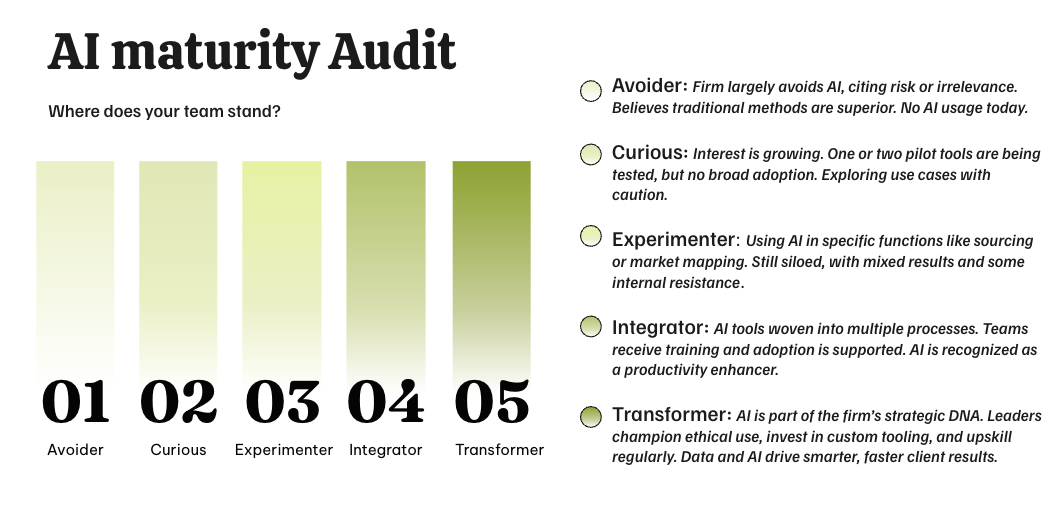
From there, you can explore how prepared your team is for AI tech. I created the “AI Maturity Audit Scale” to help teams measure their AI readiness. It’s a simple starting point that encourages inclusive change—aligning implementation with team mindset, while validating (or challenging) assumptions about AI’s role in your business.
Why does it matter? Because successful AI integration is about more than data and dashboards—it’s about people, workflow, and acceptance of “change culture”.
A regular Audit uncovers:
Where your team is (and isn’t) comfortable using AI
Ethical or compliance scenarios to dig into
Misconceptions driving your current tech strategy
The gap between optimism and actual capability
How new tools complement or clash with your existing knowledge workflows
The Audit doesn’t just diagnose—it can guide your roadmap and keeps you on point. Every time you deploy it, you’ll see where training, up-skilling, or process support is needed, and whether your assumptions about “what the team needs” are on track—or totally off-base.
The result? You invest in tools that are relevant, usable, and sustainable because they’re aligned with where your people actually are.
Because here’s the truth: Tech is only as powerful as the people and systems supporting it.
Sustainable success means embedding that continuous change into your culture—removing friction, encouraging continuous learning, and leading with purpose. Executive search firms that do this well won’t just adapt to the future—they’ll help shape it.
*https://webinar.gartner.com/731264/agenda/session/1642269?login=ML
